HFMA puts the loss at 1–5% of net revenue. Not denials. Not coding accuracy. The charge that never got entered at all — and why your AI stack can't see it.
Charge capture is still the biggest hole in the mid revenue cycle. Not denials. Not coding accuracy. The charge that never got entered at all.
HFMA benchmarks put the loss at 1–5% of net patient revenue. Run that math on your own numbers: $1M–$5M a year for a mid-size hospital. $20M+ for a large system. CFOs, that's not a rounding error. That's margin — and it's leaving the building quietly, encounter by encounter, without showing up in a denial report or a coding quality score.
Here's the part leadership consistently underestimates: you plan for the average encounter. The leakage isn't in the average. It's in the exceptions — the cases nobody designed a charge workflow for.
The rare procedure with no button on the charge menu. The supply swap that happened mid-case because the preferred item was out of stock. The 2am bedside service that clearly happened but has no obvious place to go in the charge capture system. These aren't coding problems. They're workflow gaps — moments where the clinical team had to choose between delivering care and figuring out how to document a charge that doesn't fit neatly anywhere.
Most of the time, care wins. As it should. But that charge is gone.
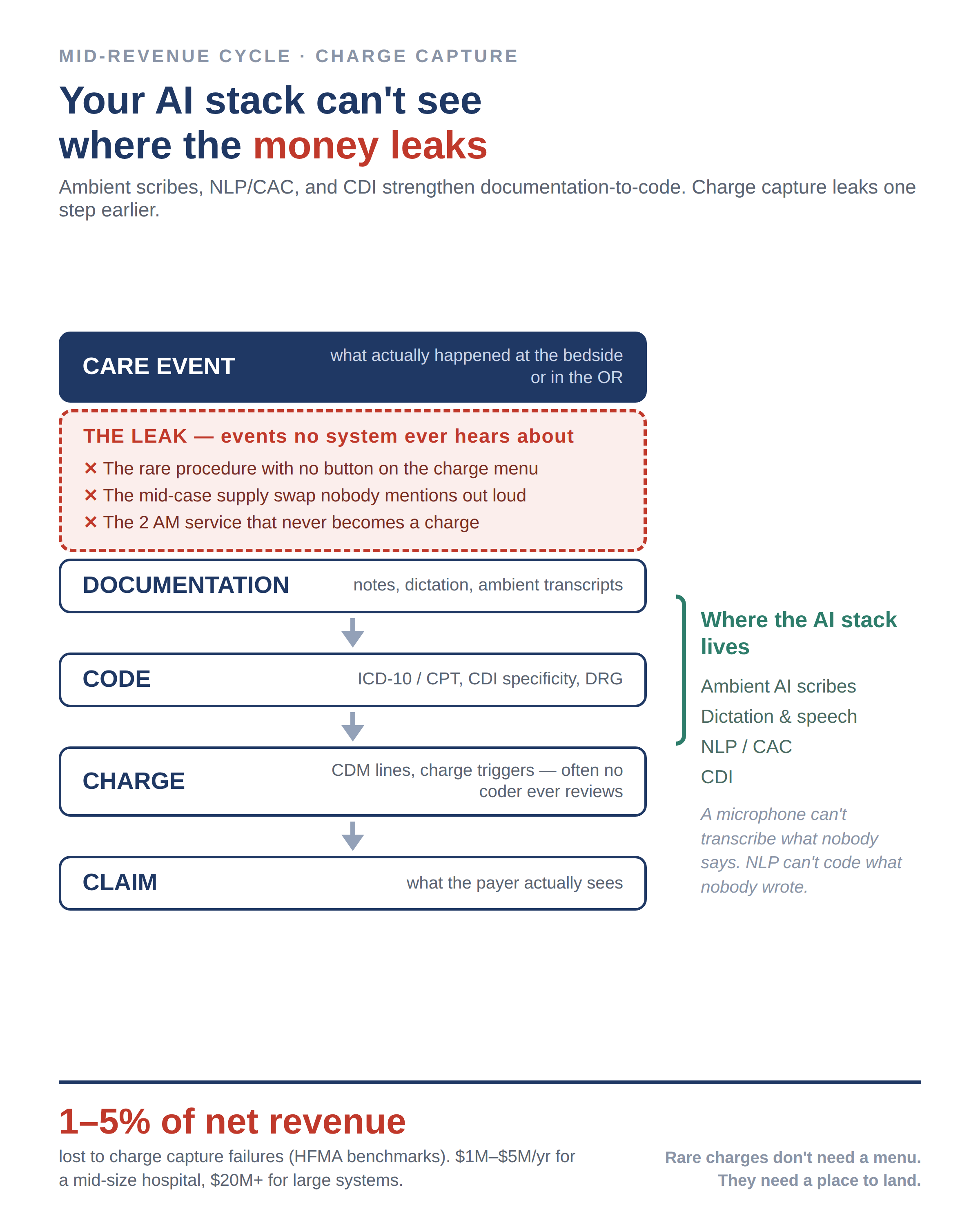
The current wave of revenue cycle technology investment — ambient scribes, NLP-assisted coding, CAC, CDI — all has a common dependency: something got documented first.
A microphone can't transcribe what nobody said out loud. An NLP engine can't extract a charge from a note that was never written. CDI queries can't improve documentation for a service that was never captured at all. And a large portion of these charges are hard-coded off the CDM anyway — no note, no coder, nothing for any AI to read.
The entire AI stack in your revenue cycle operates downstream of documentation. Charge capture leakage happens one step upstream — at events that never enter any system. That gap is invisible to every tool you've bought to fix it.
So we buy retrospective analytics and find the money 90 days later. Sometimes. But you can't pattern-mine a charge that was never entered. The analytics can show you what categories are trending low — that's useful — but they can't recover what was never captured. By the time the report runs, the clinical context is gone, the provider is on to the next hundred patients, and the likelihood of successful late billing is low.
Rare charges don't need a spot on the standard charge menu. They need a place to land. Give clinicians a low-friction way to flag it mid-procedure — a text, a voice note, a quick form on the device that's already in their hand — and route it to someone who knows what to do with it. That's not a technology problem. That's a workflow and staffing problem.
Let people who understand the CDM and coding guidelines sort it out on the back end. The clinician's job is to flag that something happened. The revenue integrity team's job is to turn it into a billable charge with appropriate documentation. Those are two different skill sets, and conflating them is exactly how charges end up on sticky notes.
This is exactly the kind of problem we work on. CODEMED brings the coding expertise and operational process design to close the gap — whether you're starting from scratch on a revenue integrity program or trying to figure out why your charge capture variance keeps coming back clean while your net revenue doesn't.
HIM directors and coding managers: where do off-menu charges go in your shop today? If the honest answer involves a sticky note, a verbal handoff, or "we figure it out later" — that's the gap. And that's exactly where CODEMED can help.
CODEMED's revenue integrity team can audit your charge capture workflow, quantify the leakage, and build the process to stop it — with credentialed coders who own the outcome.
